
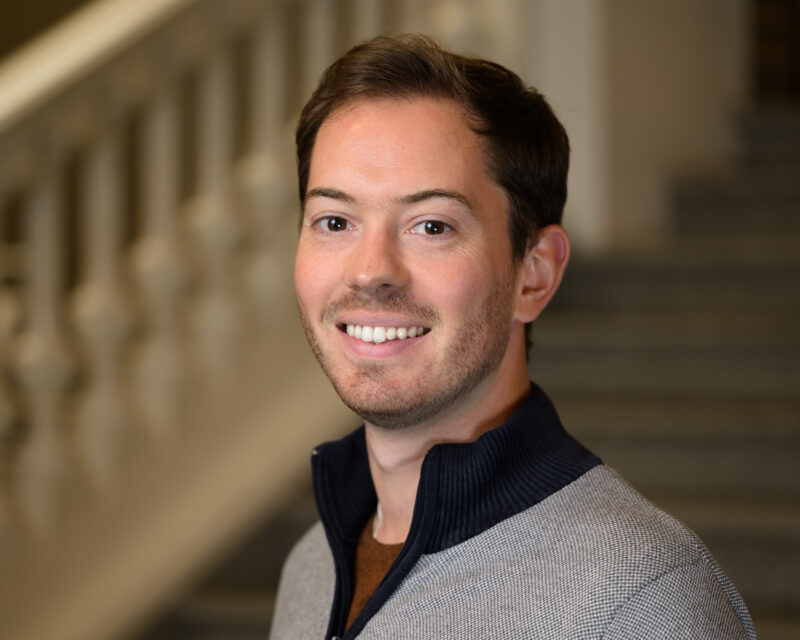
During the spring our Faces for research interview series presents Young Academy Finland’s international members. First interviewee is space physicist Maxime Grandin who has lived in Finland since 2013.
Who are you?
My name is Maxime Grandin, I am a Franco-Finnish Research Council of Finland fellow and ERC Starting Grant holder currently working at the Finnish Meteorological Institute (FMI) in Helsinki.
What is your field and your research topic?
I am a space physicist. I investigate the couplings between the Earth’s magnetosphere, ionosphere and upper atmosphere. This includes for instance research on auroral emissions; I analyse not only data measured by geophysical instruments but also aurora photographs taken by citizen scientists.
What led you to relocate to another country?
I came to Finland for the first time in 2012 when I was taking a gap year before completing my master’s studies in France. I spent six months at the Sodankylä Geophysical Observatory and I enjoyed it very much. I was then offered the chance to come back to Sodankylä to do my PhD in 2013, and since then I have not left Finland. After my PhD, I moved to Helsinki where I was a postdoctoral researcher at the University of Helsinki for eight years, and in late 2024, I started in a new position at the FMI as a researcher.
What are the pros and cons of changing your research environment?
Getting to experience not only how research is carried out, but also what life is like in another country greatly helps in adapting to new environments and challenges. It expands one’s capability to think differently and makes learning new concepts and methods easier. It is also a life-changing experience on a personal level, contributing to self-growth. On the other hand, leaving behind family and friends and having to build one’s own social network from scratch can be challenging, and it is not easy to make long-term life plans when not knowing where you will settle down.
“The relationship to work – and especially working hours – is a lot more relaxed in Finland than in France, despite the stereotypes that may exist about the latter!”
What kind of support have you received as an international researcher?
During my time as a postdoctoral researcher at the University of Helsinki, I got the opportunity to take Finnish language courses on a relatively advanced level. I also benefitted from a tax exemption during my first two years as a doctoral researcher in Sodankylä thanks to a special agreement signed in 1978 between France and Finland to support academic cooperation.
Any funny cultural misunderstandings that you have encountered?
Coming from France, I was surprised to see how early Finns leave from work in the afternoon, even though they do not necessarily arrive earlier than me in the morning. The relationship to work – and especially working hours – is a lot more relaxed in Finland than in France, despite the stereotypes that may exist about the latter!
What advice would you give for other international scholars, whether in Finland or elsewhere?
Remember to regularly take a step back and look at the bigger picture. Your life is not entirely defined by your work. Seize opportunities when they arise, create them even, but do not lose sight of yourself in the process. A researcher’s career is full of hurdles, and academia is not always fair. If you feel that your current research environment is detrimental to your mental health and that your struggles are not being heard or addressed, walk away, however impossible to envisage this may be. You have already moved across countries at least once, so you have it in you to find a new group where you will thrive and be valued for who you are!