
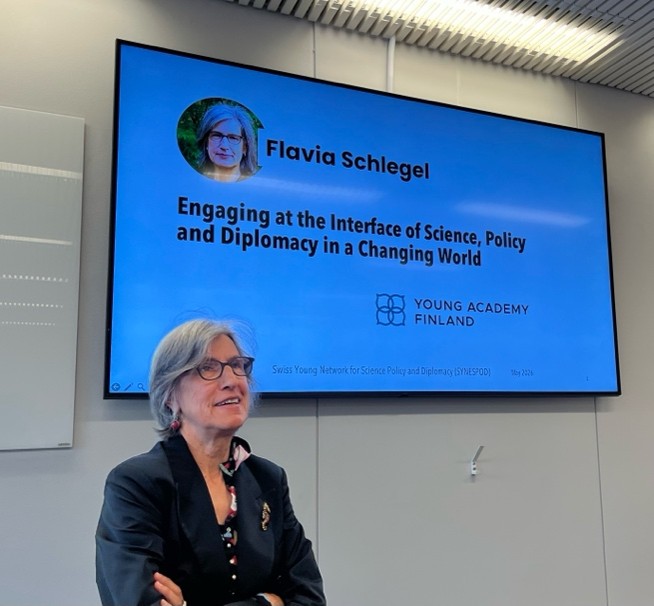
The Young Academy Finland invited internationally renowned science diplomacy expert Flavia Schlegel to speak at its Academy Club in May. The visit was part of a tour organized by the Young Academy Finland in collaboration with SYNESPOD, the network of the Swiss Young Academy. In this article the tour organizers, Veera Ehrlén and Jovana Milic, reflect on the role of science diplomacy in a changing world.
How can science continue to build bridges in a world marked by geopolitical tension, rapid technological change, pressure on academic freedom, and growing uncertainty around international cooperation? This question was at the heart of Dr. Flavia Schlegel’s visit to Finland, hosted by the Young Academy Finland in collaboration with the Swiss Young Network for Science Policy & Diplomacy (SYNESPOD), supported by the International Network for Governmental Science Advice (INGSA) Europe. Dr. Schlegel is an internationally recognized science diplomat whose career has spanned public health, multilateral science policy, and global science cooperation. She has served as Assistant Director-General for Natural Sciences at UNESCO and as the International Science Council’s first Special Envoy for Science in Global Policy. Her experience also includes science diplomacy roles in Washington, DC, and Shanghai, where she contributed to establishing Swissnex China, a transdisciplinary platform connecting science, technology, innovation, culture, and society. This background made her visit particularly timely for the academic community in Finland, where questions of science advice, international cooperation, security, sustainability, and the societal role of research are increasingly intertwined.
The visit was motivated by a shared interest in a broader conversation on science diplomacy from the perspective of early- and mid-career researchers. While science diplomacy is often associated with high-level international negotiations, Dr. Schlegel’s visit highlighted that it can also take shape in academic practice, such as in how researchers build collaborations across borders, communicate evidence in complex policy environments, and engage with societal challenges that no single discipline, institution, or country can address alone. Across Finland, Dr. Schlegel’s lecture “Engaging at the Interface of Science, Policy, and Diplomacy in a Changing World” offered a common starting point for these discussions and shared a perspective grounded in personal experiences. The discussion explored the emergence of science diplomacy and its growing relevance in the current geopolitical landscape. It asked how science can maintain its role in informing decisions, sustaining international cooperation, and creating spaces for dialogue at a time when global challenges are increasingly interconnected and politically charged. This also placed special emphasis on the role of early- and mid-career researchers. Rather than seeing science diplomacy as a field reserved for senior experts or diplomats, the discussion invited younger researchers to recognize their own agency. Building capacity for science diplomacy requires not only policy knowledge but also skills in communication, collaboration, negotiation, interdisciplinarity, and the ability to navigate different cultures. For emerging researchers, these skills are becoming increasingly relevant as academic careers are shaped by international networks, societal expectations, and complex global challenges.
The visit created an opportunity to explore these questions from several Finnish perspectives. At the University of Oulu, the discussion connected science diplomacy to the emerging transdisciplinary institute and Arctic diplomacy. Oulu offered a particularly meaningful setting for considering how research, regional expertise, Indigenous and local knowledge, environmental change, security concerns, and international cooperation intersect in the Arctic, highlighting the need for science diplomacy and cooperation across disciplines, borders, communities, and policy domains. The visit continued at Tampere University, where the focus shifted to the relevance of science diplomacy for societal interactions. Discussions in Tampere highlighted how universities can act as interfaces between research, policy, civil society, and public debate. Science diplomacy, in this context, is not only about international relations but also about how academic institutions engage responsibly with society, build trust, and create spaces where knowledge can inform action. At the University of Turku, the conversations turned toward sustainability transformation as science diplomacy was discussed in relation to long-term societal change and the need for cooperation across sectors and disciplines beyond technical solutions and toward shared understanding and the ability to connect research with policy, business, communities, and international agendas.
“Across these conversations, a shared message emerged that science diplomacy is no longer a distant or abstract concept, but may already be embedded in ways scientists collaborate, institutions build partnerships, and societies respond to complex challenges.”
The visit concluded in Helsinki at the Young Academy Finland’s Academy Club meeting, where the discussion returned to the role of early- and mid-career researchers. This final conversation brought together many of the themes raised throughout the visit, such as the need for training, networks, institutional recognition, and opportunities to participate in science-policy and science-diplomacy spaces. It also highlighted the importance of making science diplomacy more accessible, so that researchers across disciplines and career stages can relate their work to international cooperation and societal resilience. The complementary discussions opened a different window onto science diplomacy, from Arctic diplomacy and transdisciplinary research, through societal interaction and sustainability transformation, to the agency of early- and mid-career researchers. Across these conversations, a shared message emerged that science diplomacy is no longer a distant or abstract concept, but may already be embedded in ways scientists collaborate, institutions build partnerships, and societies respond to complex challenges.
The timing of the visit was particularly significant, as Europe is currently shaping a more strategic and coherent approach to science diplomacy through the development of a European framework for science diplomacy. This approach recognizes that scientific cooperation, research networks, and international mobility are not only important for producing knowledge but also for strengthening Europe’s capacity to engage constructively in a changing world. Networks such as the Marie Skłodowska-Curie Actions illustrate how researcher mobility, training, and international collaboration can contribute to this broader science diplomacy ecosystem. They create connections between people, institutions, disciplines, and countries, which are the very connections that science diplomacy depends on. This recognition further stimulates discussions in Finland, pointing to the need for more deliberate educational programs, curricula, and prospective networks to strengthen national science diplomacy capacity.
“Science diplomacy is learned not only through formal training, but also through exposure to experienced practitioners who can make visible the pathways, choices, and skills that shape work at the science–policy–diplomacy interface.”
For early- and mid-career researchers, this also underlines the importance of mentorship. Science diplomacy is learned not only through formal training, but also through exposure to experienced practitioners who can make visible the pathways, choices, and skills that shape work at the science–policy–diplomacy interface. Mentors such as Dr. Schlegel can play an important role in helping emerging researchers understand how scientific expertise can contribute to international cooperation, how careers can move across sectors and institutions, and how researchers can act with both scientific integrity and diplomatic sensitivity in complex environments. For Finland, this may open an important opportunity. With its strong research system, high levels of trust, international orientation, Nordic leadership, Arctic expertise, and a strong commitment to sustainability and technological advancement, complemented by an active early-career research community, Finland is well placed to contribute to science diplomacy in Europe and beyond. The next step is to make this potential more visible and more systematic by supporting training, building networks, recognizing science diplomacy as part of academic work, and creating opportunities for early- and mid-career researchers to learn from established science diplomats and practitioners.
This visit highlighted that science diplomacy is not only about responding to crises, but preparing researchers, institutions, and societies to work together in a changing world, which inspires consideration of opportunities to advance this meaningful vision in Finland and beyond.