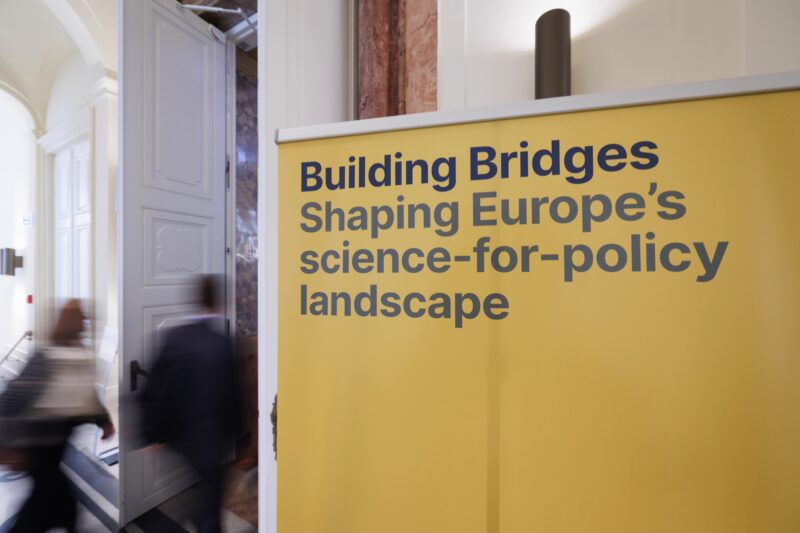
In spring 2025, Veera Ehrlén, a board member of the Young Academy Finland, took part in the Building Bridges − shaping Europe’s science-for-policy landscape conference in Vienna. In this piece, Veera reflects on the role and position of early-career researchers in the field of science advice. This article launches a new series titled Reflections from around the world, in which members and staff of the Young Academy Finland share thoughts inspired by their participation in various international events.
Research impact is often associated with grand achievements—groundbreaking scientific results that directly inform political decision-making. In reality, impact can stem from much more everyday actions that build public trust in science and scientists. This was precisely the focus at the Building Bridges − shaping Europe’s science-for-policy landscape conference held in Vienna in May 2025, which brought together researchers, policymakers, and science brokers. The event’s message was clear: trust in science, scientific institutions, and researchers must be strengthened, and Europe has the opportunity to lead the way in this work.
Trust does not build itself
The conference emphasized that trust in science among politicians, decision-makers, and citizens cannot be taken for granted—it must be built continuously. Every action researchers take to reinforce trust in scientific knowledge and in the research process is already a form of impact. It is therefore important to remember that communicating science “downwards” to citizens, especially to future generations, is just as crucial as offering science advice “upwards” to decision-makers.
When researchers visit schools (for example through the Young Academy Finland’s Meet a Researcher service), participate in panel discussions, write popular science texts, or engage in conversations on social media, they do more than simply share research findings. They help build vital bridges between science and everyday life. When science feels open and accessible, it reinforces citizens’ sense of societal belonging and supports the resilience of democracy.
“Communicating science ‘downwards’ to citizens, especially to future generations, is just as crucial as offering science advice “upwards” to decision-makers.”
The special role of early-career researchers
Early-career researchers have up-to-date knowledge of their field’s literature and the most recent scientific findings. They master the latest methods and work close to the core of research, which enables them to bring timely phenomena and fresh perspectives into public debate. However, taking research beyond academic circles is not easy. Many early-career researchers (myself included) experience uncertainty about stepping into the role of a change-maker.
Science advice is not part of most researchers’ formal training, and universities generally do not support the development of science-for-policy competencies. Scientific expertise also does not automatically translate into the ability to communicate clearly, understand political cycles, or see how research knowledge is integrated into decision-making. This is why early-career researchers need training, examples, support, and encouragement. Experienced researchers play a crucial role here, as they can open doors to influence and help young scholars navigate these networks.
“Early-career researchers need training, examples, support, and encouragement.”
Impact is built through small actions
The conference highlighted that decision-makers accept that they do not know everything about every topic—yet they can still make decisions based on the knowledge they do have. Researchers, by contrast, often feel hesitant to comment on issues if they believe they lack sufficient knowledge. This mindset can hinder impact. When the voice of the researcher goes unheard, someone else will fill the space—often with information, values, or aims that do not stem from research.
Researchers can contribute to societal discussions through small insights. This does not always constitute formal science advice, but rather offering perspective. To support this, more training and encouragement is needed, especially for early-career researchers.
Impact is slow, and its results often become visible only in the long term. It is built through small actions and through making science visible and understandable—efforts that strengthen trust and open dialogue. Maintaining trust in science is a prerequisite for the societal impact of research, because science cannot have influence unless it is heard.
“Impact is built through small actions and through making science visible and understandable.”