
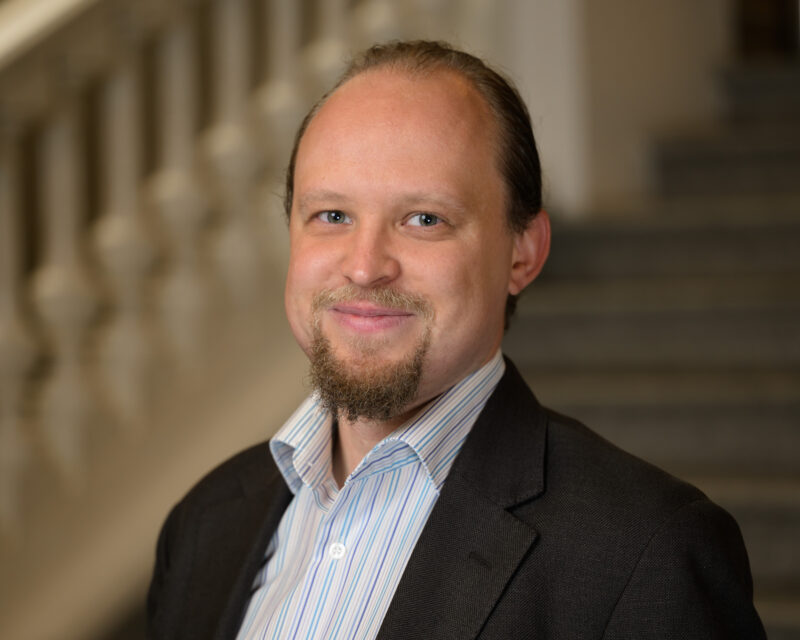
During the spring our Faces for research interview series presents Young Academy Finland’s international members. The second interviewee, Andreas Hauptmann, values the work-life balance in the Finnish academic environment.
Who are you?
I am Andreas Hauptmann, currently working as Academy Research Fellow and Associate Professor of Computational Mathematics at the Research Unit of Mathematical Sciences in the University of Oulu, where I have been since 2019.
What is your field and your research topic?
I am researching Inverse Problems, which can be understood in an abstract way as “determine an unknown quantity with the help of external measurements, when the measurement process is known”. More concretely, our research group is interested in medical imaging and tomographic applications, such as computerized tomography and magnetic resonance imaging. When data is corrupted by noise or accelerated scan times, advanced mathematical methods are needed for obtaining a reliable image, which are developed and implemented in our group. I particularly enjoy the highly interdisciplinary nature of my field.
“I always valued the approach to science in Finland, which managed to combine and balance highly competitive research with a healthy work-life balance.”
What led you to relocate to another country?
I did an Erasmus exchange in 2010 at the University of Helsinki, during which I learned about Inverse Problems. Consequently, I started my PhD in 2013 in Helsinki. I always valued the approach to science in Finland, which managed to combine and balance highly competitive research with a healthy work-life balance.
What are the pros and cons of changing your research environment?
My first change of environment was during my exchange year, when I learned a different approach to studies and university life. In Helsinki, students and teachers had a closer and more personal contact than at my home university in Germany. My second change was during my postdoc at University College London, where I learned to perform in a very competitive environment and which involved personal sacrifices. This helped me to shape my own approach to research and find a balance for leading a successful and supportive research group.
“In Helsinki, students and teachers had a closer and more personal contact than at my home university in Germany.”
What kind of support have you received as an international researcher?
My biggest support came from my PhD supervisor and the Finnish Inverse Problems community, which is exceptionally welcoming. When I returned to Finland after my postdoc I was already equipped with necessary knowledge to navigate the landscape of Finnish academia.
Any funny cultural misunderstandings you’ve encountered?
I believe German and Finnish culture is not too different for serious misunderstandings, both are rather straightforward and actually tell you “how they are” if you ask them. Nevertheless, I have troubles to accept uunimakkara.
What advice would you give for other international scholars, whether in Finland or elsewhere?
It is important to make contacts. Don’t be shy, talk with your colleagues and meet new people. Learn about the research environment as well as the culture of your new (or temporary) home.