
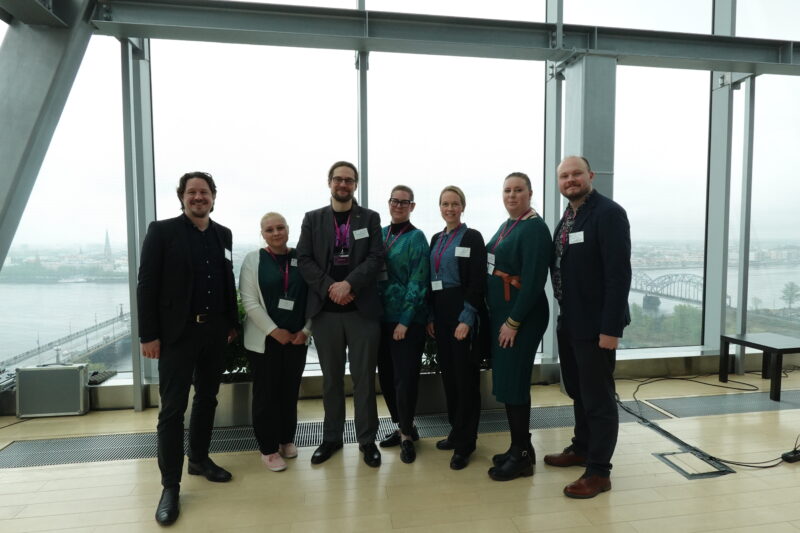
In May 2026, Elisa Vilhunen, a board member of Young Academy Finland, participated in the Nordic Baltic meeting of young academies in Riga, Latvia. In this article, Elisa reflects on how security and academic freedom are intertwined in the present moment and how society benefits from free science.
Photo: Young Academy Finland members and staff at the Nordic Baltic meeting of young academies on the 11th floor of the National Library of Latvia.
At the Nordic Baltic meeting of young academies held in Latvia last May, participants engaged in wide-ranging discussions about the role of science in security issues and the dilemma between academic freedom and societal responsibility. Where should the limits of academic freedom lie when societal security is under threat? Should researchers follow their curiosity, or should they focus on responding to the challenges facing their societies and their times? And what do we actually mean by security: strong military defense, stable societies, or the capacity to understand one another? These discussions gave rise to one particular thought for me: from the perspective of security, the question may not be how much society can afford to invest in free science, but rather how long it can afford not to.
Free science is the starting point of the university mission
As a Finnish researcher, the question of whether universities should serve society feels somewhat unfamiliar. After all, the three core missions of universities, research, teaching, and societal engagement, are already defined in the Finnish Universities Act (558/2009, Section 2):
“The mission of universities is to promote free research and scientific and artistic education, to provide higher education based on research, and to educate students to serve their country and humanity. In carrying out their tasks, universities shall provide opportunities for lifelong learning, interact with the surrounding society, and promote the societal impact of research results and artistic activities.”
From the perspective of Finnish university legislation, the question is therefore not whether science should be free or serve society. It must do both. At the same time, the Universities Act makes it clear that freedom is a fundamental principle of science: the right to formulate one’s own questions and investigate them without external direction. Free inquiry should therefore be the foundation of university activity. Its purpose is to provide the basis for both teaching and societal engagement, rather than adapting itself to whichever expectations society may hold at a given moment.
Science cannot exist independently of society. It is conducted within society, funded by society, and its impacts extend across multiple sectors of society. Yet long-term, curiosity-driven research may be the most important way to address questions that have not yet entered public debate but may later prove decisive for societal well-being, stability, and security.
Crises narrow the scope of research
One of the speakers at the Nordic Baltic meeting reminded us that Ukraine currently does not have the same opportunity to engage in debates about academic freedom as many other European countries. When a state’s very existence is under threat, research investments inevitably have to be directed toward issues with immediate relevance to national security. This observation raises a further question: what should we do in societies where such compulsion does not yet exist?
“As security concerns become more urgent, expectations of science also change. In times of crisis, science is no longer merely one societal actor among many. It becomes a critical resource.“
Perhaps there is no single universal answer to the tension between freedom and responsibility in research. How these two principles are balanced depends, at least in part, on time, place, and circumstances. As security concerns become more urgent, expectations of science also change. In times of crisis, science is no longer merely one societal actor among many. It becomes a critical resource.
Security is about much more than defense
When discussing research related to societal security, attention turns quickly to fields that have a direct connection to defense or security. In Latvia, discussions likewise revolved largely around such themes, including dual-use technologies. However, viewing national security primarily through the lens of defense technology is a rather narrow way of understanding security. In societies that are not facing an acute crisis, we have the opportunity to examine security in a much broader and more forward-looking way.
Coincidentally, while in Latvia I was reading End Game: Tipping Point for Planet Earth? (2017) by Anthony Barnosky and Elizabeth Hadly. Unexpectedly, the book provided an interesting perspective on the security-related discussions at the meeting. Barnosky and Hadly (pp. 193-194) write:
“When people need something they believe others are getting more than their fair share of, and especially when those others have the power to determine their own share, the resentment they feel can erupt into full-scale conflict. […] It is not really scarcity itself that provides the motivation for war. The motivation already exists at a much deeper emotional level, rooted in long-held beliefs that refuse to tolerate alternative beliefs. Scarcity simply provides the perfect opportunity, or excuse, for acting upon grievances that have accumulated over generations.”
It is therefore evident that security issues extend far beyond the defense industry. They are also closely linked to such matters as food, energy, and infrastructure, not to mention people’s experiences and emotions. The stability of societies does not depend solely on material resources but also on how reality is understood. This idea is not new. The opening words of the UNESCO Constitution remind us that: “Since wars begin in the minds of men, it is in the minds of men that the defences of peace must be constructed.” In other words, security is not built only through weapons systems or infrastructure. It is also built through knowledge, education, and learning.
“Thinking and understanding are not separate from security policy. They shape the worldviews that people develop and the possibilities for action they consider feasible.”
Building security is therefore not solely the responsibility of technical and natural sciences. Equally – or especially – important is social science and humanities research that helps us understand inequality, polarization, trust, cultural tensions, and the flow of information within society. Thinking and understanding are not separate from security policy. They shape the worldviews that people develop and the possibilities for action they consider feasible. In this sense, diverse research and education can be regarded as the foundation of security. Free science is one of the most important ways of building long-term security.
Conclusion
Following the discussions in Latvia, academic freedom appears to me more clearly than ever as a security issue. If security is understood broadly, it must also encompass those research questions whose relevance to security is not immediately obvious. The security crises of the future will arise not only from defense systems or their shortcomings, but also from resource scarcity, social tensions, distorted information, and an inability to understand the world around us.
For precisely this reason, the value of free science often becomes visible only in hindsight. During crises, the scope for independent research almost inevitably narrows. In more peaceful times, societies have the opportunity to invest in knowledge whose significance is not yet fully understood. From the perspective of security, the question is therefore not whether society can afford free science, but whether it can afford to be without it.
This text is a machine translation of the Finnish original, checked by the author.