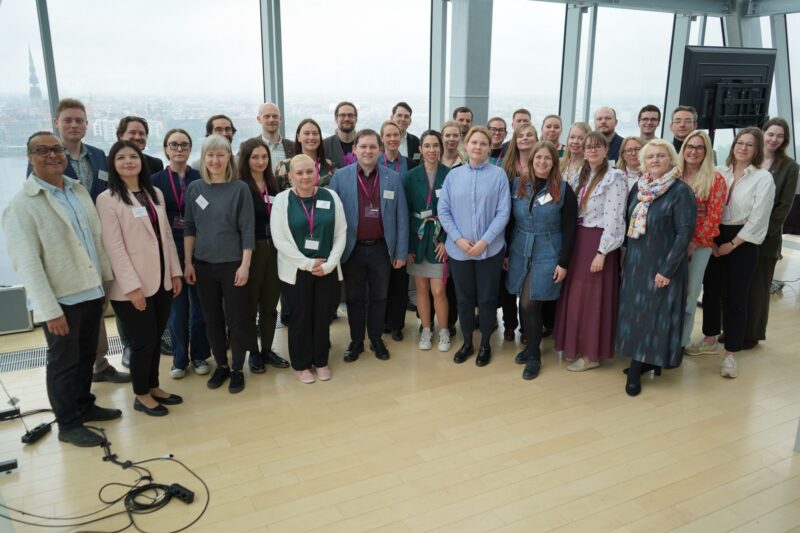
Nordic and Baltic young academies assembled in Riga during May 12 and 13, 2026. Young Academy Finland took part in the event together with sister academies from Sweden, Norway, Denmark, Estonia, Lithuania and Latvia.
This year the Baltic and Nordic young academies met in Riga, the capital of Latvia. The Castle of Light, a local architectural pride built in 2014 and designed by Latvian architect Gunnar Birkerts, served as the event venue. The Castle of Light hosts the Latvian National Library where the meeting was held on the eleventh floor.
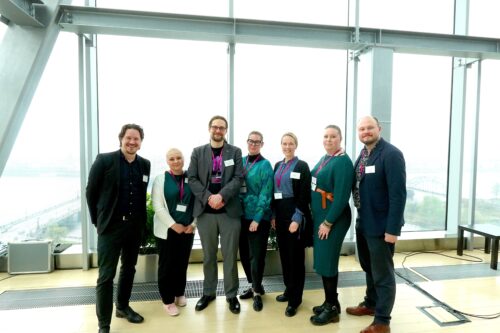
The views could not have been greater and conversations were likewise elevated. The theme of the first day was the very broad concept of resilience. Member of Young Academy Finland, Hannah Yoken, spoke of the peace movement in the 1980s and its scope in the context of that period. The anti-nuclear weapons movement was also extremely vast and brought about real change in terms of disarmament. Yoken highlighted the role of researchers within the peace movement and was also interviewed by a local radio station about the topic. This arguably signals that the issue is once again topical and shows that by learning from history we can make the world a better place.
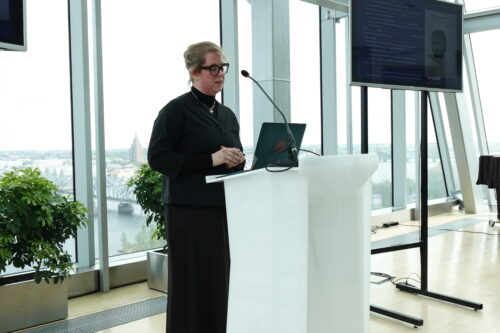
The resilience theme was continued by Laura Bacete Cano from Sweden who spoke about grain resilience and how we may prepare for food safety related biological threats. Lithuanian Andrius Tamošiūnas spoke of energy safety from the perspective of reuse of waste energy. Latvian Ingus Pērkons discussed chemical risks: how risks can be dealt with and how they can be researched. Norwegian Erik Sveberg Dietrichs spoke of cold resilience and how we can prevent cold-related deaths in the northern latitudes.
The theme of the second day was freedom of science. The first part of the day was, however, dedicated, as per tradition, to presenting the activities and recent achievements of each young academy within science communication, science policy or science education. Young Academy Finland’s activities and events from the past year were presented by board members Sampsa Holopainen and Hannah Yoken together with science education coordinator Kim Krappala. Particularly January’s panel discussion about the Finnish Publication forum and our Meet a Researcher service along with other activities related to it, such as the Mene ja tiedä online journal, sparked a discussion. 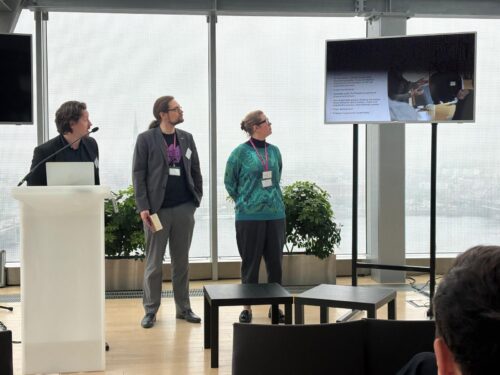
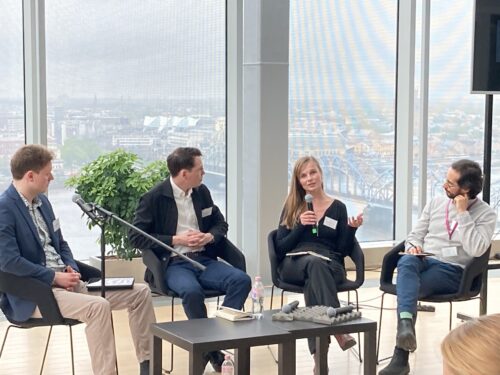
Professor Sanita Osipova’s key note speech was the first to touch upon the theme of the day. The talk focused on academic ethics and the integrity of science. In addition to general principles, she highlighted local concerns. Osipova’s talk was followed by a workshop on the topic where the aim was to provide tools for influencing local level science policy. After this Dagnija Baltiņa from the Latvian National Library gave a talk on the current state of academic freedom. The day ended with a panel discussion, led by Oskars Teikmanis, about the state of academic freedom. Panelists included science historian Christoffer Basse Eriksen, lingvist Guro Nore Fløgstad and resilience scholar Juan Carlos Rocha Gordo.
Guro Nore Fløgstad’s thoughts about how the freedom of science is often understood differently within academia than outside it struck a chord. Within academia that freedom is often perceived, following the dichotomy by Isaiah Berlin, as positive freedom, that is, freedom to the resources necessary for conducting research (means, infrastructure and personnel). In this day and age, the principal concern for scholars is the cessation of long-term research and the ability to build know-how, and thus the loss of human capital. Outside academia the freedom of science is intuitively thought to imply negative freedom, that is, freedom from physical boundaries, outer threats (censorship or punishment) or demands that research should be politically steered in any way. This semantic duality is highly visible also in public discussion about science policy in Finland where the discussing parties are often unable or reluctant to understand each others’ viewpoints.