
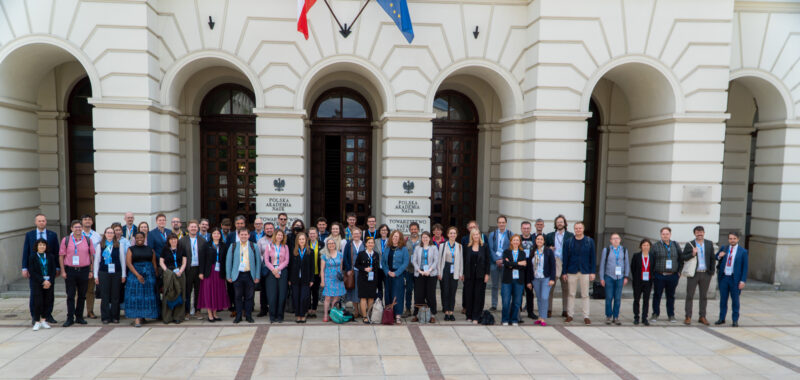
ENYA meeting participants in front of the Polish Academy of Sciences (photo by Piotr Terlecki / Polish Academy of Sciences)
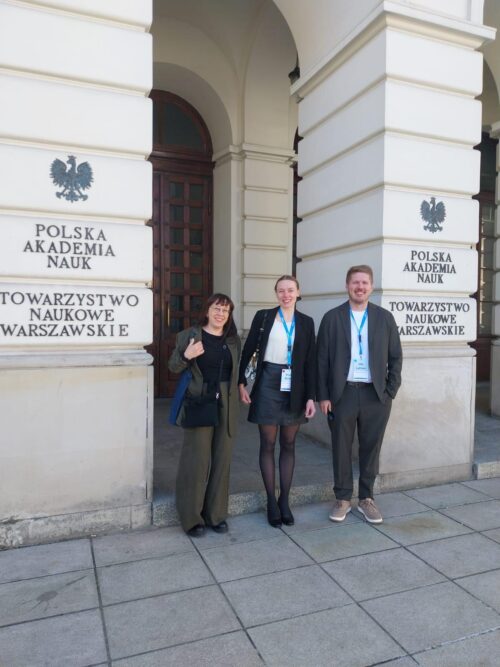
Young Academy Finland’s delegates attended the European Young Academies (ENYA) meeting and the All European Academies (ALLEA) general assembly in Warsaw during May 27-29. Science secretary Riikka Hiltunen and board members Veera Ehrlén and Ville Laitinen participated in the meetings.
Representatives from 24 countries took part in the annual meeting of the European Young Academies, which rendered the meeting the largest thus far. The main themes of the event, hosted by the Polish Academy of Sciences, were academic freedom and trust in science which were discussed in smaller groups.
A need for strengthening the co-operation among European young academies, potentially via a new umbrella organization, arose in the conversations. Currently, young academies form an informal network, with Young Academies Science Advice Structure (YASAS) operating alongside. As neither of these is an official organization, some of the administrative duties and communication have been transferred over to Global Young Academy and Young Academy of Europe. Participants were favorable towards the establishment of a new umbrella organization, perceived to facilitate European level co-operation and advocacy work. YASAS general meeting also took place in conjunction with the meeting. The next European young academies meeting will take place in Edinburgh on May 26–28, 2027.
The ALLEA assembly highlighted that scholars and research institutions have to defend science as a global good even more firmly and strengthen international collaboration and take part in societal discussion. The meaning of scholarly activism and the need to oppose trends that weaken the status of science were also discussed. The future president of the International Science Council (ISC) Robbert Dijkgraaf summarized in his keynote speech that geopolitics is too grave a matter to be left solely to politicians. The topical nature of the meeting was emphasized by the researcher and student protests against the chronic underfunding of Poland’s science and higher education sectors that took place the same day in Warsaw.
The workshop organized by SAPEA (Science Advice for Policy by European Academies) looked at the diversity of science advice. Introductory presentations noted how political polarization, geopolitical transformations and the structural disunity of science produce added pressure for science advice and the people who create it. Discussions highlighted the significance of diversity for the quality of and trust in science advice; at the same time, also factors such as structural inequalities, poor incentives, and career risks were recognized as limiting participation. The central conclusion of the workshop was that science needs to offer open, transparent and participatory modes of operation as well as realistic guidelines in an insecure world situation.